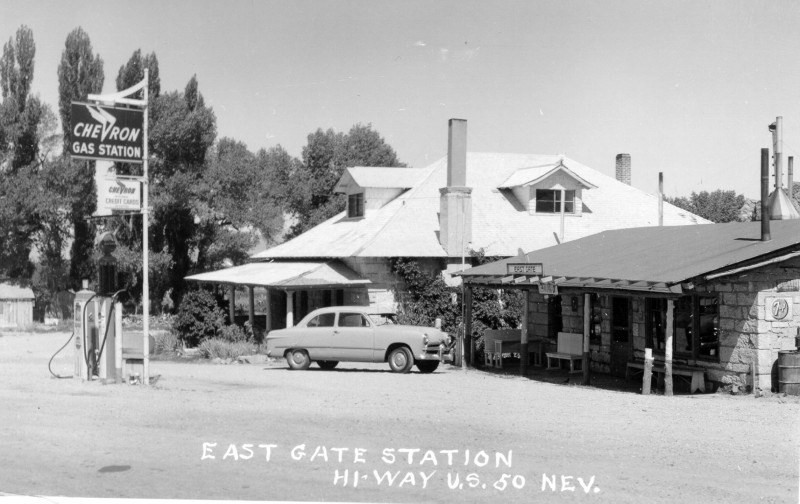
Eastgate

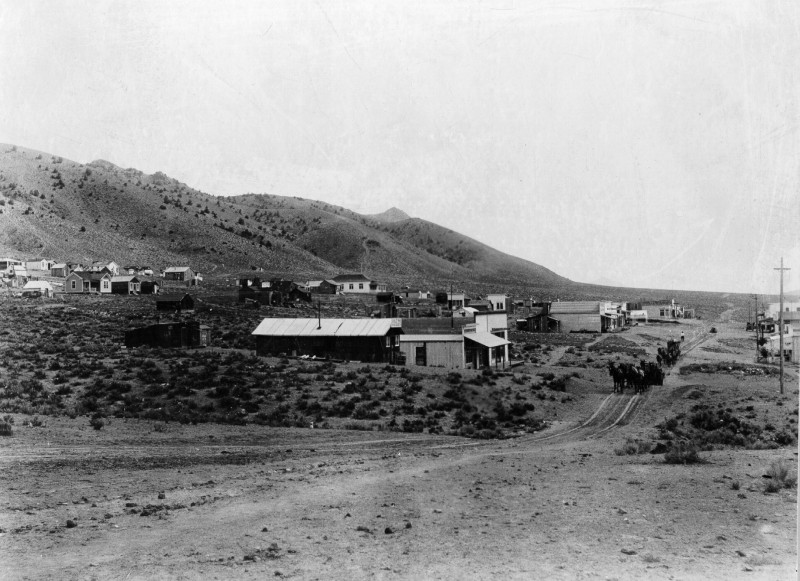
The Monarch in Fairview

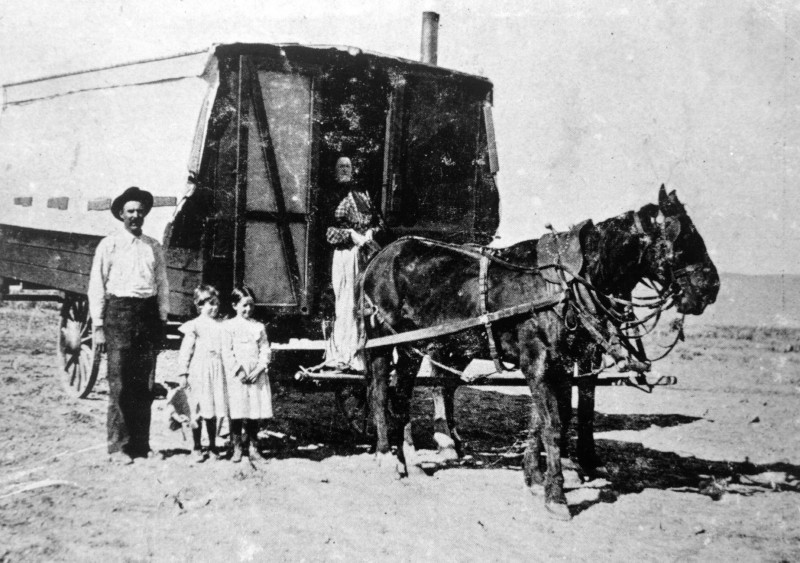
Fairview prospectors

Delivering Water to Fairview

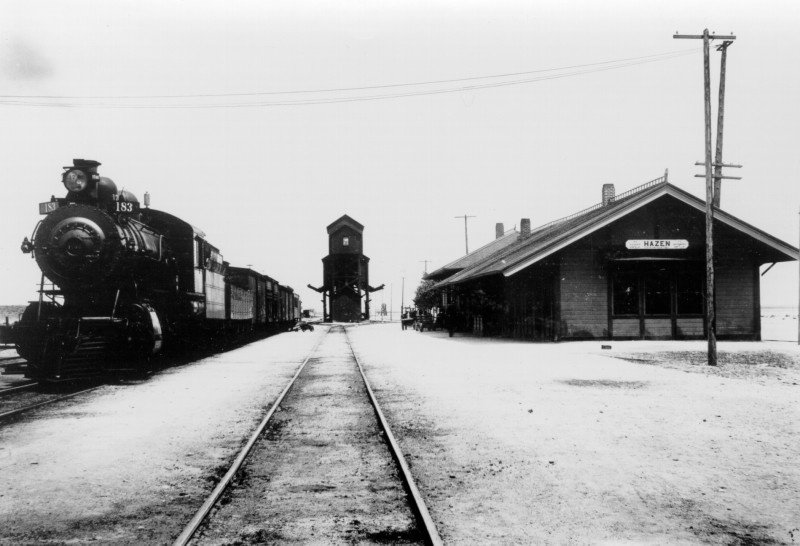
The Train at Hazen

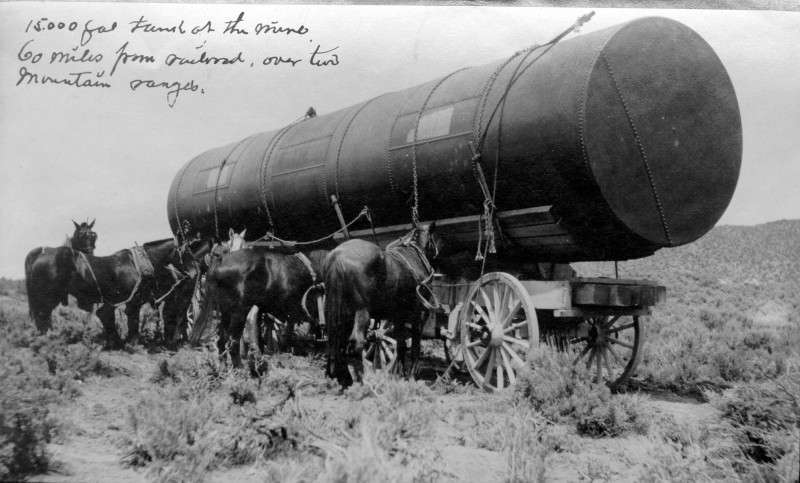
Tank being delivered to Wonder

Freight wagon in Wonder

Photos courtesy
Churchill County Museum.
From top to bottom:

Automobile resting at the Easgate Store; Something mobile in front of the Monarch in downtown Fairview; Fairview prospectors and their wagon; delivering water to Fairview; the train pulling into (or out of) Hazen; a rather large tank being delivered to Wonder; a freight wagon making it's way through Wonder

TRANSPORTATION

Transportation options in the nineteenth century were a bit more limited than they are today, particularly in the Great Basin. A trip from Fallon to La Plata to Wonder to Fairview and back to
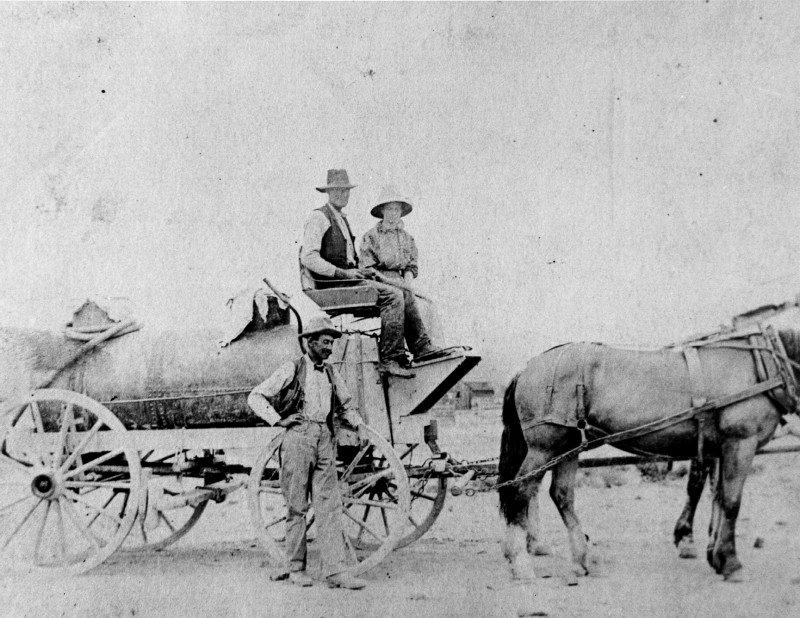
Fallon- a 130 mile day trip today- was a two week journey by ox or mule-powered freight wagon. A stage between Fallon and Fairview, leaving Fallon at 7:00 a.m. and changing horses at Grimes Ranch and Sand Springs would reach Fairview about 6:00 p.m. If the roads were dry, an automobile of the day could make Hazen to Fairview in about five hours.

Just as you plan your route today by the availability of gasoline and drive-up windows, the nineteenth century driver planned his route by the availability of good roads, water, and hay, all scarce in Churchill County.

While you munch french-fries in air-conditioned comfort, think of the men struggling to drive heavy freight wagons in the blistering sun and stabbing wind, their eyes filled with sand, as they plodded along at 3 miles per hour.
When you reach into your cooler for an icy-cold soft drink, think of the men who combed the canyons and valleys accompanied only by a mule or two and their dog. Even as late as 1916, it was a bit tougher to get around than it is today. Firmin Bruner wrote about returning from a trip to the big city of Fallon to pick up a few things:

" I passed West Gate at dusk and had driven about four miles into the canyon toward Mud Springs when an axle broke. I walked back to West Gate and asked Mr. and Mrs. Salisbury, who tended the water pumps for Fairview, for lodging. They fed me and placed a cot in the front room for me.

"The next morning Mr. Salisbury drove me out to my truck, taking with us tools and plenty of blocking. About noon we had replaced the broken axle with a new one which I carried for emergencies. He charged me $5.00 which included the $1.50 for lodging.
The truck wouldn’t pull the last little pitch at the top of Mud Springs summit, so I had to unload and take the potatoes up in two trips. By the time I had re-loaded the last five sacks, I was so hungry and weak that I hardly made it, but after stopping at the Mud Springs Station and filling up on some of Mrs. Kinney’s good food for fifty cents, I felt like I was a brand new boy." (Bruner-Some Remembered... Some Forgot- Life in Central Nevada Mining Camps)

Now there is a guy who's prepared- he brought an extra axle. This is an excerpt of travel experiences on what is now a very dry, level, and straight Highway 50 East out of Fallon:

" When we left Fallon we had before us a very trying drive. The country east of Fallon, past Salt Wells Ranch and as far as Sand Springs, was in bad condition because of recent heavy rains. We met heavy wagons drawn by ten, twelve, fourteen, and sometimes sixteen horses and mules, struggling madly and almost hopelessly through the sticky mud. The drivers were cracking their whips, yelling and swearing, and the poor animals' flanks and bellies were thick with mud. The heavy wagons were piled high with bales and boxes. In some instances the horses of one team were being unharnessed to be added to another team where the wagon stuck hopelessly in the mud.
"A country woman told me later that she had seen the horses of these trucking teams come in at night, their flanks covered with the dried blood which and streamed down from the wounds made by a pitchfork in the hands of a desperate and angry teamster determined to get his team started out of a mud hole.
"We had an advantage because of the broad tires of our machine, and got on very well by picking our way across the plain and keeping well to the left of a long stretch filled with salt water holes and with a fairly large salt lake. A new road had been made by travelers, far away from the regular road, which ran close to this inland sea and which was a hopeless quagmire. " (Gladding- Across the Continent by the Lincoln Highway)

You would be wise to prepare for poor conditions whenever you travel to any of the sites we mention here. Unless they traveled it yesterday, you would be wise to take with a grain of salt any advice given to you about road conditions, particularly in canyons. Comments like these are the rule rather than the exception:
"There was formerly a road up the canyon to the mines, but it has been completely washed out, and the mines at present can be reached only on foot through a steep-walled canyon."

(University of Nevada, Nickel Deposits In Cottonwood Canyon)

4WD Pickups

We've updated our "big" rides.

Used to was we had pickups, like Luis's short wheelbase Chevy, and my way-too-long wheelbase Ford. The nice thing is, of course, you can slam your ATV in the back, cinch it down, and be off. Drive until you're afraid of getting the truck stuck, pop out on the ATV's like a couple of TIE fighters squirting out of the Death Star.

There's only so many people you can cram into a pickup, unless you have a crew-cab, whose wheelbase is so long as to make it worthless for even rudimentary off-roading. A pickup is a pretty specialized vehicle, and if you're not hauling stuff at least 25% of the time, you kinda wonder, after a while, why you're driving it.

Considering the fact that we do most of our exploration on ATV's, we had to have a way to transport them. If you can't carry them, you have to pull them. To pull them you have to have a trailer. This is a pain, but then you are freed from having to drive a vehicle whose sole purpose is to carry cargo.

After failing to convince our wives that we should be able to buy two Unimogs, we upgraded our transportation to evil Sport Utility Vehicles. Luis, always jealous of the superiority of my Ford over his Chevy, purchased an Explorer; while I, realizing the shortcomings of FoMoCo products, went with a Trail Rated™ Jeep Cherokee.

We can put both our ATV's on my spanking new Forgotten Nevada Quad Transport Platform

Now our wives are happy because they can go get groceries when it snows and not have to put them in the back of the bed- we have a dry windless place to curl up if we get stuck or lost, better gas mileage in these days of $3.00+ a gallon gas, and I'm sure it ticks off a tree-hugger or two because we have SUV's, not stopping to realize that the pickups were far, far worse.

ATV

During our explorations we've found that there are numerous places where a truck just can't go. Or maybe your truck is a daily driver and you don't want to risk your ride to work by pushing it through Washout Canyon. In that case, you can off load your ATV and go just about anywhere.

We stick to roads and trails because [cough] we're adults and it's the responsible thing to do. Believe me, the "roads" we've been on are challenge enough- there have been a few times we wondered if we were going to make it back.

Bob rides an Arctic Cat 500 Manual 4WD ATV water-cooled 4 stroke shaft-drive. It can carry lots of goodies and go many places, but there is a weight penalty- it weighs almost 650 pounds. Lots of ground clearance, though- enough to pass over a cinderblock.

Luis gets by on his new[ish] Polaris 500 4WD. 4 stroke, water-cooled, automatic transmission, shaft drive. He got tired of riding his little 2WD 325 chain drive, but mainly he wanted to be more like me- and who doesn't? I don't have a picture of it so I stole one of the net and slapped it on top of his old picture. He got the Winchester Edition, but it didn't come with a gun, so what's the point?

Ride responsibly. The last thing I need is to have some rancher tell me I can't ride here any more because some drunk pinhead was out on an ATV tearing things up.

Shoes

You REALLY want to see a larger picture of my boots, huh? Hmmmmmmm.
As distasteful as it sounds, sometimes you just have to hoof it. Believe it or not, I've found my Redwing #2243's to be comfy, tough, and snake-proof. Great for walking on all kinds of Nasty Surfaces. A bit warmish in the summer, though.

Since we are True Twenty-First Century Men, we don't walk when we can ride. However, some of the places we've gone would be perfect for hiking, and I suspect that you'd want a pair of genuine hiking boots instead of steel-toed wonders.

Whatever you wear, make sure they're comfy, because it's a long walk home.

GPS
You gotta get oneEven the most basic GPS will save you hours of walking or riding up the wrong canyon, following the wrong road, or looking for that special site. They can be had for about a hundred bucks, and you really should think about getting one. I started out with a Magellan 315 and worked my way to a Garmin Extrex Vista. You can upload way points and routes from your computer mapping program into the unit, and download where you've been when you get back. So, if you find Chuck's Lost Silver Mine you can mark it in the GPS, and know exactly how to find it next week when you return with your dynamite and shovel. The Etrex Vista model allows you to upload USGS maps to the unit, so you can actually follow your progress on the map. I will warn you that it's really really dangerous to try to watch where you're going on the map and not watch the road. Always stop before you look at your GPS. Luis wasn't impressed until the road we were on vanished, as they sometimes do, and I was able to take the GPS and walk through the saplings and brush to where the road was hidden. Very handy device.
PDA

The limitations of a GPS become apparent when you're trying to look at the tiny 160 x 288 pixel, 1 1/4 by 2 1/4 inch monochrome screen. But when you hook it up to a PDA with a 240 x 320 pixel, 2 1/2 by 3 inch color screen, why it's, well, it's bigger and more cool.

The only problem is, while the GPS is made to ride clamped to your handlebars out in the wind and the rain and the dust, the PDA is a Delicate Thing that must remain tucked safely in the confines of your zipped and padded camera bag, taken out only when you require a larger and more colorful view of where you are, then returned to its safe little cocoon before anything happens to it.

On the other hand, you can use it to record things like notes, voice clips, and even entertain yourself with a game while you're waiting for... uh... something.

Protection

Of course, when we leave on a trip I have to promise Luis's wife that I'll take care of him and bring him back safe and sound. The environment in which we travel is fraught with danger, and there have been several times when I was glad I was armed. Although I'm sure those two liquored-up cowboys really did just want to show us the historical aspects of their respective bunkhouses, having my fingers curled around the Pachmayr grips of my S&W Model 19 as we declined their offer gave me a warm, fuzzy feeling those crocked cowpunchers would never know.

While an old-fashioned wheel-gun has it's advantages, there's nothing like a good old-fashioned Model 1911 in .45 caliber to make you feel all warm and snuggly. Developed as a revolver replacement way back in 1911 by firearms genius John Moses Browning, this version with a shorter barrel has a few amenities and improvements over the 93 year old design, but it's basically the same gun. Interestingly, while it is no longer the official sidearm of the U.S. military, having switched over to the 9mm Berreta in 1985 to keep our NATO buddies happy- it is still used by special operations units of the U.S. Army, Navy, Marine Corps, the FBI, and other agencies.

Radio

Sorry- no bigger picture availableIt's nice to be able to communicate with your travel partner and to do that we use radios. You can buy FRS (Family Radio Service) radios cheap, and for the most part they'll do nicely. We use a pair of GMRS radios (General Mobile Radio Service. License required- it's the old Class A Citizens Radio Service) simply because they really reach and and touch someone compared to the FRS- roughly a five mile range versus two. We find they work in the canyons a bit better.

The GMRS radios often tend to cover FRS frequencies as well. We usually use a pair of FRS radios to communicate truck-to-truck on the way out to the site, and then strap on the GMRS radios once we're on the quads.

Sometimes we wonder what it would be like to come across a band of 1850's immigrants while riding on our ATVs, guided by our GPS and PDA, talking on our GMRS, looking for a place to eat our MRE's.


Return to Previous Document | HOME | Stuff I'd LIKE To Have If Money Were No Object